As part of our Education Programme, Caabu delivers talks at schools around the UK. Below are some of the most frequently asked questions regarding our school talks programme.
What is Caabu’s school talks programme?
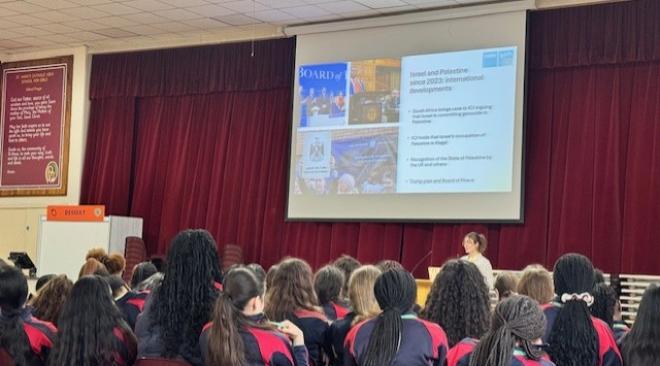
We run an active and engaging education programme, providing expert speakers to address knowledge gaps about the Arab world and Middle East at British schools and universities. We hold talks, workshops and debates in schools around the UK on a variety of topics.
What topics does Caabu’s programme cover?
Caabu’s speakers can cover a wide range of topics within the organisation’s expertise of the Arab world and Middle East. Our most frequently requested topics include:
- Introduction to the Arab World, the Arabic language and Arab culture
- Situation in Israel and Palestine
- Arab and Muslim stereotypes and images of the Middle East
- Refugee Crisis
Are Caabu’s school talks politically neutral?
Our sessions give students the opportunity to hear an informed perspective and engage directly through questions. They are purely educational in purpose, designed to deepen understanding of current affairs through evidence-based content that fosters critical thinking and respectful discussion.
How much do Caabu’s school talks cost?
As part of Caabu’s mission as a non-profit, we offer school talks free of charge. We do ask schools outside of London to reimburse travel costs for speakers, or to pay a fee for events longer than three hours. Voluntary donations are welcome.
Who delivers Caabu’s school talks?
Caabu’s school talks are delivered by experienced practitioners with subject expertise. Our Education Coordinator, Lily Wood, leads on delivering school talks but other experts are also part of our programme.
How do Caabu’s school talks support the curriculum?
Sessions are designed to complement various school subjects such as History, Politics and Religious Studies. Our workshops often align with curriculum themes and can be tailored to a specific exam board.
Can the programme help with university applications?
Participation can strengthen understanding of global issues and critical thinking skills, which can in turn support university applications in subjects like International Relations, Politics, History, Middle Eastern Studies and beyond.
Can teachers see Caabu’s materials in advance of a talk?
Yes. We develop our sessions on an individual school basis in close coordination with class teachers, meaning teachers are able to see exactly what materials go into a particular talk.
Are Caabu’s school talks age-appropriate?
Given the nature of the subject we work on and the ongoing situation in the region, difficult issues can come up. Our speakers are experienced in facilitating such discussions sensitively and impartially, and our session materials are tailored to the specific needs of each school.
We design each workshop to be suitable for a given age group. Practically, this means using appropriate language, explaining complex or advanced topics accessibly, avoiding overly graphic or distressing images, and overall avoiding certain topics if unsuitable for a given age group.
We develop our workshops on an individual school basis in close coordination with class teachers. No new material that hasn’t been shared in advance with teachers will be covered. Teachers are encouraged to share with us any needs or sensitivities of particular students, such as relevant lived experiences or backgrounds.
Is the programme inclusive?
Caabu promotes respectful dialogue and values diverse perspectives. Sessions are designed to create a safe space for discussion.
Who can I contact to discuss further?
If you have any questions or would like to discuss booking a talk, please do not hesitate to reach out to Lily, our Education Coordinator, at [email protected].